




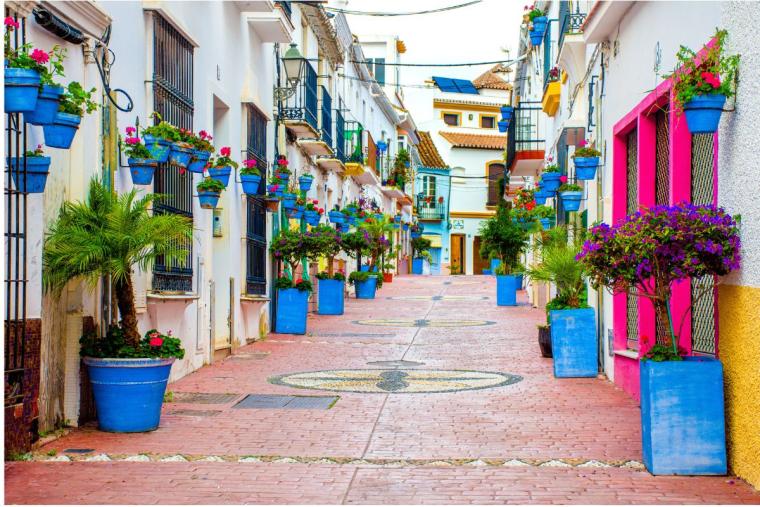
Discovering Estepona old town
Picture whitewashed streets bursting with colorful flowers, charming little squares perfect for a quick breather, and unexpected works of art around every corner. Estepona old town perfectly preserves the essence of a traditional Andalusian village while transforming its historical heritage into a vibrant, beautifully maintained place for a stroll.
The best way to explore is simple: take a leisurely wander from Plaza de las Flores toward the historic Barrio de la Villa, leaving plenty of time to get lost down any side streets that catch your eye. Along the way, you'll discover one particular spot that perfectly captures the town's historical evolution, which you'll encounter a bit further ahead.
What to see in Estepona old town
When deciding what to see in Estepona old town, the answer goes far beyond any single monument. The real appeal lies in the seamless blend of traditional architecture, rich historical heritage, blooming flower pots, street art, and vibrant daily life.
This revitalized center features a maze of narrow, whitewashed streets—the very reason Estepona has earned the nickname ‘Garden of the Costa del Sol’.
Plaza de las Flores, the heart of Estepona
Plaza de las Flores is one of the best starting points for your visit. This pedestrianized square is framed by historic buildings, lovely gardens, and outdoor terraces, all centered around a beautiful fountain. You'll also find the Casa de las Tejerinas and the Tourist Office located here.
The atmosphere shifts beautifully throughout the day. Peaceful mornings are perfect for admiring the historic façades, while the afternoons bring a lively energy as visitors flock to the terraces.
Barrio de la Villa: the town’s living history
From Plaza de las Flores, make your way to Barrio de la Villa, where the original core of Estepona old town once lay. These streets reveal Estepona's deep historic roots, making it easy to imagine how the town originally expanded around its defensive walls.
A prime example is the ruins of San Luis Castle, a coastal fortress built in the late 16th century to protect the shoreline. Thanks to recent restoration work, you can now view sections of the original wall and explore different historical eras through archaeological remains and interpretive displays.
This spot best captures Estepona’s transformation: a defensive structure that remained partially hidden among houses for centuries, and which today helps us understand the town’s origins.
Plaza del Reloj, the iconic landmark
Plaza del Reloj is another must-see stop on your tour. Its standout feature is the Clock Tower, linked to the former 16th-century Church of Los Remedios.
After the devastating 1755 earthquake, the ruined church was eventually demolished, but the tower survived. In the early 20th century, a clock was added, and it continues to mark the time in the center of Estepona today.
A town of murals and poetry
Another distinctive feature of Estepona is that art isn't confined to museums. As you wander, you'll discover large-scale murals, sculptures, and poetry plaques integrated directly into the urban landscape.
The Poetry Trail invites you to read pieces by various authors in multiple languages as you explore the town center. Additionally, dedicated mural and sculpture routes turn the streets into an incredible open-air museum.
Since not all artworks are concentrated strictly within the oldest district, you can easily extend your walk to neighboring areas. It is precisely this sense of discovery that makes walking around Estepona such an enjoyable experience, even without a detailed map.
Where to eat in Estepona old town
After a morning of exploring the squares and streets, you'll find inviting terraces, tapas bars, and restaurants scattered throughout the center. The culinary scene allows you to switch between traditional Andalusian specialties, fresh seafood, Mediterranean staples, and modern fusion dishes.
Among the flavors most associated with Estepona, seafood and dishes linked to its agricultural and fishing traditions truly stand out. However, the current variety means there is something to suit all tastes and occasions, as you’ll see in this guide on where to eat in Estepona.
Elba Estepona Gran Hotel & Thalasso Spa, your coastal retreat
Exploring the town can easily take up a full morning or afternoon, especially if you combine your stroll with a meal and a cultural walking tour. To round off the experience, the Elba Estepona Gran Hotel & Thalasso Spa provides an idyllic seaside retreat.
Situated right on the beachfront, this five-star hotel features a luxurious thalassotherapy center dedicated to your relaxation and wellbeing.
Staying here gives you the best of both worlds: on one hand, the vibrant, history-steeped streets of Estepona old town; on the other, the soothing tranquility of the Mediterranean Sea when you return to the hotel. It’s a perfectly balanced way to discover the destination, enjoy its cuisine, and set aside essential time to relax.


